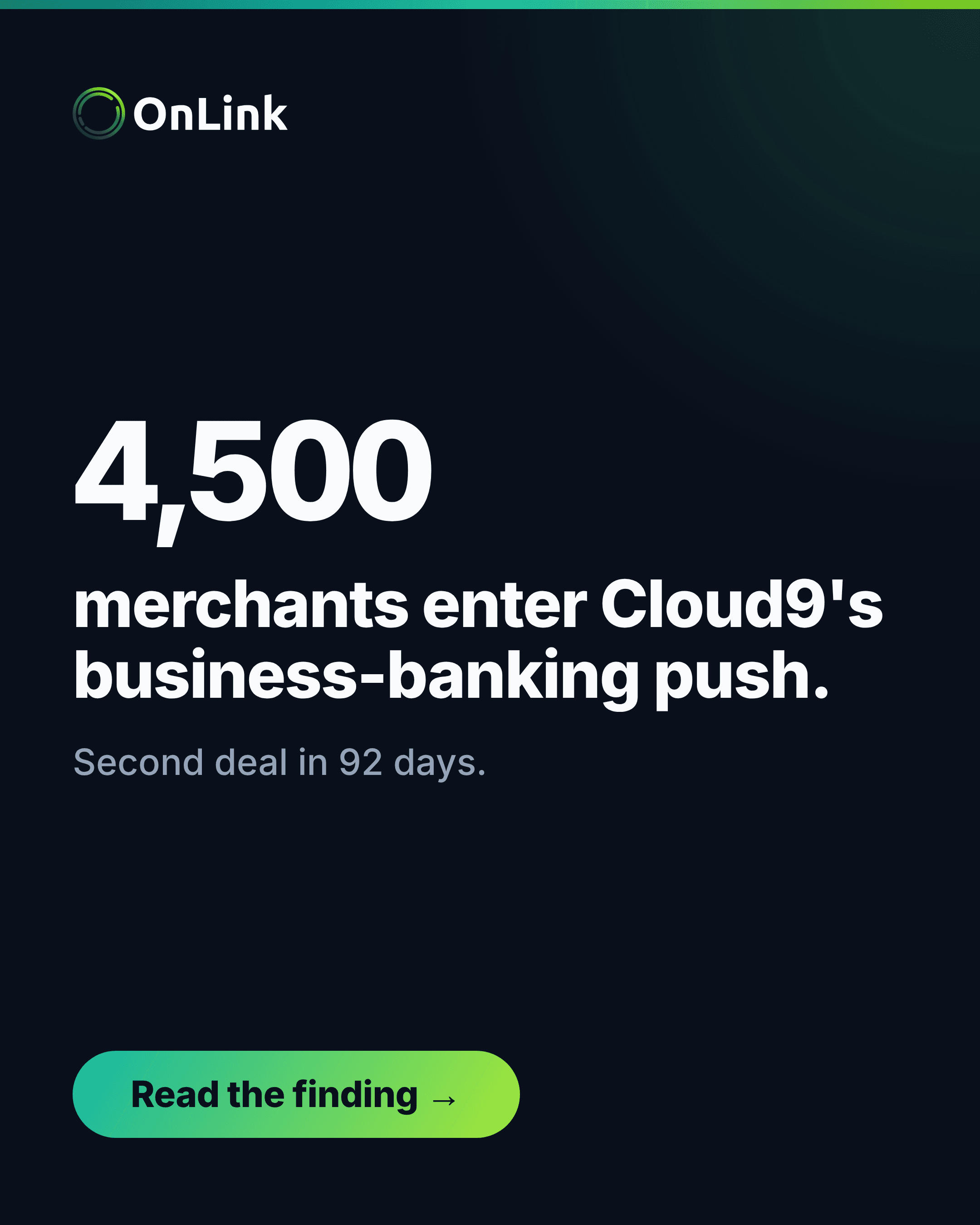
Cloud9 buys Chpter 92 days after its first acquisition
Cloud9's second deal in 92 days brings Chpter's 4,500-business commerce base into banking, but its announcement publishes no FX rate, fee or delivery time.
2 min read
The partnership targets institutional settlement and treasury workflows, not a new consumer payment product — and any rollout will depend on regulation.

Pan-African payments network Onafriq has partnered with wallet-infrastructure provider Privy to develop stablecoin-enabled payment infrastructure for businesses across its network. The first phase is focused on cross-chain stablecoin transfers, treasury and settlement workflows, according to Onafriq's 29 July announcement.
That distinction matters. This is not an announcement of a new stablecoin for consumers, nor a promise that businesses can immediately pay suppliers with digital assets. It is a plan to build the underlying capabilities that banks, fintechs and payment providers could use for settlement and liquidity management where regulation permits.
Cross-border payments in Africa can move through several banks, payment networks and currency conversions before the recipient is paid. That can tie up working capital and make it harder for a business to know when funds are actually available.
Onafriq says the Privy partnership is intended to address this infrastructure layer: faster settlement and more efficient treasury workflows. In its independent report, The Kenyan Wall Street similarly describes the initial work as settlement and treasury operations before any broader cross-border payment and liquidity use cases.
For African businesses, the potential benefit is not the technology label. It is whether a payment provider can reduce the time and cost between sending money in one market and having usable funds in another.
Onafriq's release says Privy will provide wallet infrastructure, while Onafriq works on embedded digital-asset capabilities for partners and, eventually, institutional clients. Onafriq says those services will be offered only where regulation allows.
That qualification is important. A faster settlement rail does not remove the need for licensed financial institutions, customer due diligence, sanctions screening, foreign-exchange controls or clear rules on digital-asset activity. It also does not guarantee a lower customer price: the final cost still depends on the provider's FX rate, fees and the local payout route.
The partnership is therefore best understood as an infrastructure development, not a finished cross-border payment service. Its practical impact will depend on regulatory approvals, the countries and institutions that adopt it, and whether it produces a measurable improvement in speed, liquidity or cost.
For Kenyan SMEs paying overseas suppliers or receiving foreign-currency revenue, the persistent question is straightforward: how quickly can money be converted and made available, and what does that process cost?
Our USDT-to-KES cost example shows how that question turns into final shillings on a 10,000 USDT off-ramp. The live USD/KES converter supplies the reference-rate context for the calculation.
Stablecoin-based settlement is one possible way payment providers may try to improve that back-end process. But businesses should judge any eventual offering on the fundamentals: the exchange rate, total fee, delivery time, regulatory protections and how reliably funds reach the final account or wallet.
As this partnership develops, those are the outcomes worth tracking — rather than assuming that a new settlement technology automatically makes a payment faster, cheaper or safer.
Editorial
The OnLink editorial team writes about money, payments and multicurrency banking for people and businesses moving money in and out of Kenya.
Cloud9's second deal in 92 days brings Chpter's 4,500-business commerce base into banking, but its announcement publishes no FX rate, fee or delivery time.