Fintech trends reshaping payments in and out of Africa
Five fintech shifts from late 2026, from stablecoins to M-PESA's global links, and what they mean for businesses moving money in and out of Africa.
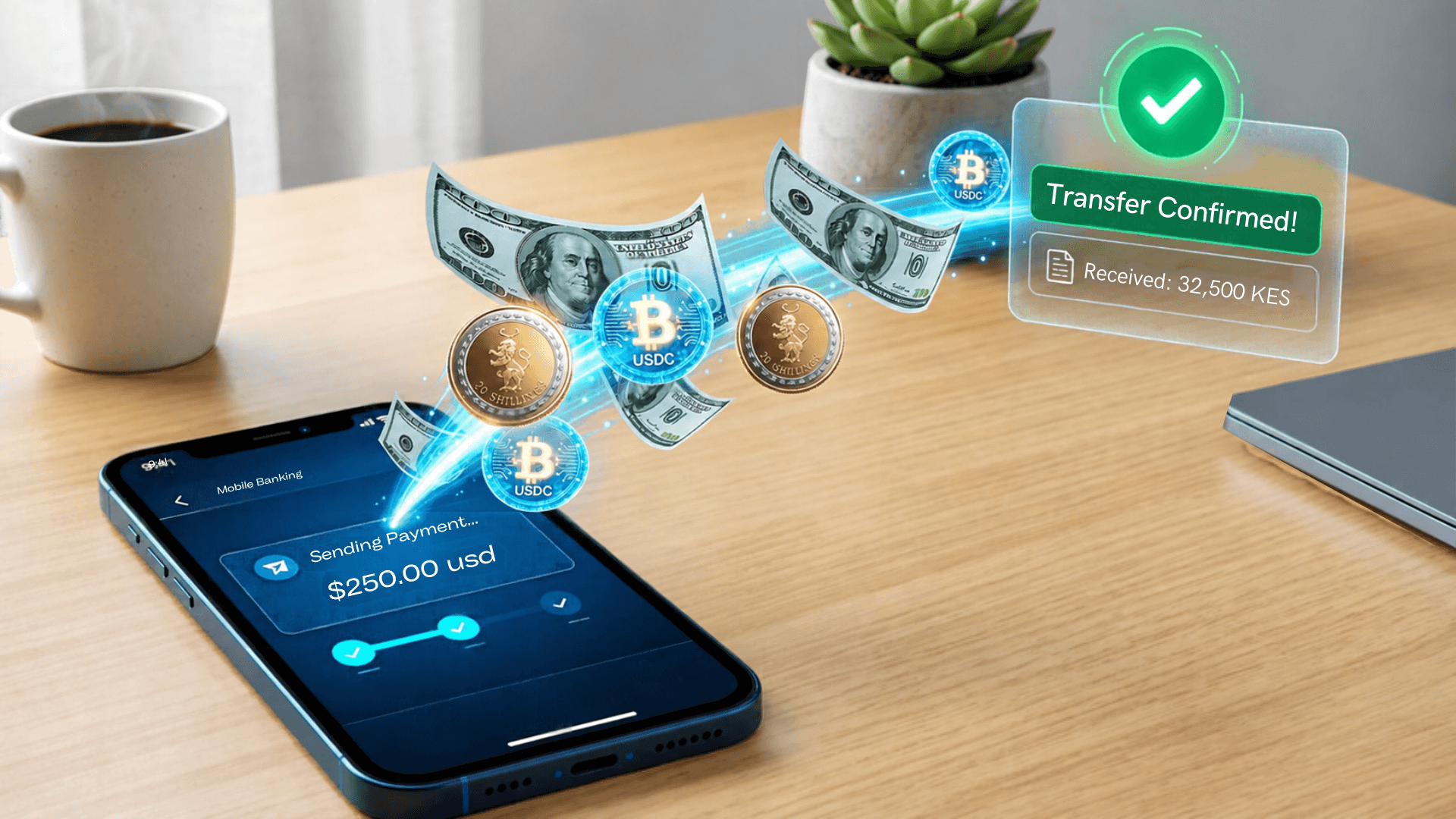
The phone on your desk is now a payment network
Cross-border money is starting to move the way messages do: from a phone, in seconds, at any hour. In the past few weeks, phone makers, global banks and card networks have all put stablecoin payments into everyday products. Kenya has opened licensing for the businesses that move digital dollars.
Yet sending money into Sub-Saharan Africa is still the most expensive in the world. On the World Bank's latest figures it costs 8.46% to send $200 to the region, or $16.92 of every $200 (African Exponent).
Here are five fintech shifts from late 2026, and what each one means if your business pays or gets paid across African borders.
1. Stablecoins are becoming ordinary business rails
Stablecoin payments grew 45% to $482 billion in the first nine months of 2026, while total stablecoin supply barely moved, up 0.4% to $305 billion (CoinDesk via KuCoin). The same digital dollars are being used again and again to pay for things, not just held. September set a monthly record of $72 billion in payments.
The brands involved are no longer crypto start-ups:
- Phones. Samsung put USDC accounts inside Samsung Wallet for eligible US Galaxy users on 5 November, reaching about 82 million devices, with bank payouts in more than 60 countries (Wisdom of Wallets).
- Payment networks. Circle's payments network reached $41.3 billion in annualised volume by the end of September, more than 15 times a year earlier (CoinDesk via KuCoin).
- Rules. The US GENIUS Act, which bars stablecoin issuers from paying interest to holders, takes full effect in January 2027 (Tech Times).
For a Kenyan exporter or a remittance company, the practical change is speed and hours. A stablecoin transfer settles in seconds, seven days a week, with no bank cut-off times or weekend holds.
2. Mobile money is plugging straight into global rails
In 2026, M-PESA stopped being only a domestic wallet. Three deals show the shift:
- Coinbase and Thunes (October). A business holding USDC can now pay out to M-PESA and Airtel wallets across Sub-Saharan Africa through one integration. The money arrives as local currency, and the recipient never touches crypto (Tech Times).
- Visa, M-PESA and Onafriq (July). A pilot in the DR Congo settles M-PESA top-ups in stablecoins in the background (Techno Time).
- Vodacom Tanzania and Thunes (May). M-PESA users in Tanzania can now pay merchants in Uganda and China (The Paypers).
The bigger win for businesses is cash flow. Paying out to several countries used to mean keeping money parked in a local bank account in each one. With one stablecoin balance that pays out locally, that idle cash is freed (Tech Times).
3. The true cost of sending money is finally visible
The cheapest services prove low prices are possible. The World Bank's index of the three cheapest services on each corridor averaged 3.29% worldwide, close to the UN's 3% target for 2030 (African Exponent).
Most money still moves through expensive channels, though. Here is what $200 costs to send, by region and channel, in the World Bank's latest data (Q3 2025):
| Route or channel | Cost (% of $200) | Cost on $200 |
|---|---|---|
| Through a bank | 14.99% | $29.98 |
| To Sub-Saharan Africa (average) | 8.46% | $16.92 |
| Global average | 6.36% | $12.72 |
| Through a digital service | 4.59% | $9.18 |
| UN target for 2030 | 3.00% | $6.00 |
Source: World Bank Remittance Prices Worldwide, Issue 54, as reported by African Exponent.
The biggest part of that cost is often hidden. It sits in the exchange rate margin, not the fee. A quote with "zero fees" can still cost you several percent if the rate is poor. Always compare the final amount received, not the headline fee.
4. Software, and AI agents, are starting to pay
More and more payments are started by software, not by a person tapping a button. Analytics firm Allium counted 68.3 million payments made by AI agents in the third quarter of 2026, double the quarter before (CoinDesk via KuCoin). They are tiny for now, about 5 US cents each, but the count is climbing fast.
The building blocks are arriving quickly. Stripe's Link began letting a shopping agent spend from a USDC balance on 26 October, and Coinbase built x402, an open way for AI agents to pay websites directly in stablecoins (same source).
Industry voices quoted in the same report say businesses need clear spending limits and approvals before they let agents pay at scale. For finance teams, the lesson is practical: choose payment partners with a clean API, signed requests and a full audit trail. Then your own systems, and later your agents, can move money safely.
5. Kenya has moved from grey zone to licences
Kenya's Virtual Asset Service Providers Act took effect on 4 November 2025. The regulations that put it to work were gazetted on 22 July 2026 (Cryptocurrency Regulations). Firms already operating had until 4 November 2026 to comply, and the licensing process is now open.
- Two regulators. The Central Bank of Kenya (CBK) licenses stablecoin issuers, wallet providers and payment services. The Capital Markets Authority (CMA) licenses exchanges, brokers and tokenisation platforms.
- Applications open. On 13 November the two regulators told anyone providing or planning to provide these services to apply for a licence. The CBK charges a KSh 100,000 application fee per activity.
- No licence list yet. As of 16 November, neither regulator had published a list of licensed providers, and neither had extended the deadline.
The tax rules changed too. The 3% tax on the value of digital asset transfers was replaced by a 10% excise on platform fees (Cryptocurrency Regulations).
For businesses, this is good news. Clear rules make it easier to tell regulated providers from the rest. Before you move money with any provider, ask who regulates them and where your funds are held.
What this means for your business
If you pay suppliers abroad, collect from overseas clients or run payouts across East Africa, four questions now matter more than the headline fee:
- What lands at the other end? Compare the final amount received, including the exchange rate margin.
- Is the rate firm? A quote that holds while you place the order removes surprises on large invoices.
- Which rails can it reach? Look for M-PESA, bank transfer, SWIFT and stablecoin rails from one balance, so you are not keeping cash idle in several accounts.
- Who regulates it? Check registrations and banking partners before you send.
That is what we built OnLink to do. Through one API you can collect in USD, GBP, EUR, KES or USDT, convert at a firm quote, and pay out to M-PESA, PesaLink, banks, SWIFT or Tron wallets. OnLink Technology, Inc. is registered as a money services business with FinCEN in the US and FINTRAC in Canada. OnLink is not a bank: banking services come from a partner licensed and regulated by the Central Bank of Kenya.
See it for yourself on our new website: onlink.africa. Check today's live rate, or talk to us about your corridor.
Sources
- Stablecoin Market Cap Stagnant Amid Rising Payment Volumes in 2026 (CoinDesk report via KuCoin, 8 November 2026)
- Today in Stablecoins: November 5, 2026 (Wisdom of Wallets)
- Stablecoin Cross-Border Payments Hit M-Pesa and GCash as Coinbase Joins Thunes' 140-Country Network (Tech Times, 20 October 2026)
- Visa, M-Pesa Launch Stablecoin Pilot to Transform Cross-Border Payments in Africa (Techno Time, 3 July 2026)
- Thunes and Vodacom Tanzania launch cross-border M-Pesa payments (The Paypers, 6 May 2026)
- Sending $200 Home to Sub-Saharan Africa Costs 8.46%, the Highest Price in the World (African Exponent, 5 November 2026, from World Bank RPW Issue 54)
- Kenya Cryptocurrency Regulation 2026: Laws and Licensing (Cryptocurrency Regulations, reviewed 16 November 2026)
- OnLink (product, coverage and regulatory details)
Editorial
The OnLink editorial team writes about money, payments and multicurrency banking for people and businesses moving money in and out of Kenya.